
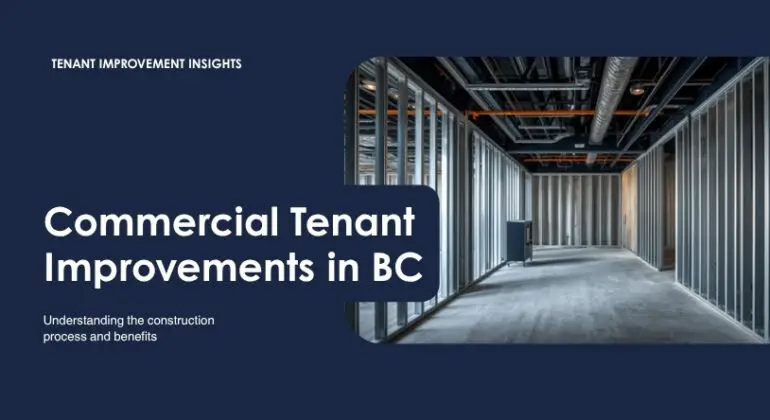

Whether you’re a building owner preparing a new shell for an incoming tenant, or a business operator fitting out your first commercial space in Metro Vancouver, the commercial tenant improvement (TI) process in BC involves more moving parts than most people expect. Permits, trade sequencing, code compliance, and budget control all need to happen in the right order — and with the right contractor.
At Shivaji Construction Ltd., we specialize in commercial interior construction across the Lower Mainland. This guide breaks down every phase of a TI build-out so you know exactly what to expect — and how to avoid the most common, costly mistakes.
What Is a Tenant Improvement (TI) in Commercial Construction?
A tenant improvement — also called a TI, build-out, or commercial fit-up — refers to the interior construction work done to customize a leased commercial space for a specific tenant’s use. This includes everything from partition walls and ceilings to electrical, plumbing rough-ins, millwork, and finishes.
In BC’s Lower Mainland, TI projects range from simple office fit-outs to complex multi-trade builds for medical clinics, retail anchors, restaurants, and institutional spaces. Under the BC Building Code 2024, all commercial TI work above a defined threshold requires permits, inspections, and compliance with applicable codes — including seismic, fire, and accessibility requirements.
Phase 1: Pre-Construction — Design, Permits, and Scope Definition
This is where the majority of TI projects succeed or fail. A well-scoped pre-construction phase prevents scope creep, budget overruns, and permit delays that can push your opening date back by months.
Lease Review and Landlord Coordination
Before a single nail is driven, the lease must be reviewed carefully. Key items include the Tenant Improvement Allowance (TIA), who holds the permit, landlord approval requirements, and base building conditions (HVAC, electrical service, demising walls). At SCL, we review these documents with our clients before any design work starts.
Design and Drawings
For most commercial TI projects in BC, you’ll need stamped drawings from a licensed architect or designer. The drawing set typically includes floor plans, reflected ceiling plans (RCPs), and details for any LGSS (light gauge steel stud) framing, fire-rated assemblies, and accessibility compliance.
Permit Submission
In Metro Vancouver, commercial building permits are submitted to the applicable municipality — City of Vancouver, Burnaby, Richmond, Surrey, etc. Processing times vary significantly. Vancouver City Hall can take 8–16 weeks for commercial permits; suburban municipalities are often faster at 4–8 weeks. We coordinate permit submissions directly, reducing the back-and-forth between the design team and building department.
Pro tip: Apply for your permit the same week you finalize drawings. Waiting until the permit is in hand to start procurement will cost you 6–12 weeks of schedule.
Phase 2: Demolition and Site Preparation
Once the permit is issued and the space is turned over, demolition begins. For shell spaces this may be minimal. For existing fit-outs being re-purposed, demo can involve removal of existing non-structural partitions, ACT ceiling grid and tile, existing millwork and casework, and mechanical and electrical rough-in.
In BC, any demolition involving suspect materials in buildings pre-1990 requires a designated substance survey and abatement before general demo proceeds. This is a WorkSafeBC requirement — not optional.
Phase 3: Rough-In Trades — Framing, Mechanical, Electrical
This is the largest phase by duration and cost on most TI projects. Trade sequencing matters here — doing things out of order means rework, and rework kills your budget.
LGSS Framing and Structural Partitions
Light gauge steel stud (LGSS) framing is the industry standard for commercial interior partitions in BC. It’s dimensionally stable, non-combustible, and required by code in most commercial occupancy types. SCL’s framing crews specialize in complex partition layouts, full-height walls, and fire-rated shaft wall assemblies.
For demising walls between tenants and corridors, the BCBC 2024 typically requires a minimum 1-hour fire-rated assembly. In high-rise or sprinklered buildings, specific STC (Sound Transmission Class) ratings are also required — a detail that gets missed on a surprising number of TI projects.
Mechanical Rough-In (HVAC, Plumbing)
Mechanical rough-in runs concurrently with framing where possible. In most BC commercial buildings, the base building HVAC is a VAV (Variable Air Volume) system that needs to be balanced and zoned for the new layout. The TI contractor coordinates with the mechanical engineer and property management to ensure tie-ins are approved and sequenced correctly.
Electrical Rough-In
Panels, conduit runs, and device boxes are roughed in before drywall. In BC, all commercial electrical work must be performed by a licensed electrical contractor and inspected by the Electrical Safety Authority (ESA). Panel upgrades and service extensions require coordination with the building’s electrical room and BC Hydro — which can add 4–8 weeks to schedule if not planned early.
Phase 4: Drywall, Insulation, and Firestop
Insulation
Batt insulation is installed in exterior walls for thermal performance and in interior partition walls for acoustic control (STC compliance). The BC Energy Step Code now applies to many commercial TI projects — confirm with your designer whether your project triggers Step Code requirements.
Drywall (Gypsum Board Installation)
Commercial drywall differs from residential in two key ways: assembly thickness and fire ratings. Most commercial partitions use 5/8″ Type X gypsum board on both sides of steel stud framing to achieve a 1-hour fire-rating. Double-layer systems are used for 2-hour assemblies in stairwells, elevator shafts, and demising walls. SCL’s drywall crews hold experience with Level 4 and Level 5 finish specifications required for high-end commercial interiors, medical facilities, and institutional spaces.
Firestop Systems
Firestopping is one of the most code-critical and frequently under-inspected items on a TI project. Every penetration through a fire-rated wall or floor assembly — pipes, conduit, ducts, cables — must be sealed with a listed firestop system that maintains the assembly fire-resistance rating.
Under BCBC 2024 Division B Part 3, the firestop installer must use a ULC-listed system and provide documentation at project completion. SCL installs and certifies all firestop systems in-house, eliminating the coordination gap between trades.
Phase 5: Ceilings — ACT Seismic Systems
In most BC commercial spaces, the finished ceiling is an Acoustical Ceiling Tile (ACT) system — suspended grid with 2×2 or 2×4 tiles. For projects in Seismic Zone D (which covers most of Metro Vancouver under BCBC 2024), ACT systems must meet seismic bracing requirements.
SCL installs seismic ACT systems in compliance with BCBC 2024 Section 4.1.8, using approved seismic bracing at required intervals and perimeter angles. A failed seismic inspection will shut down your ceiling work and delay your opening — this is not an area to cut corners.
Phase 6: Finishes, Millwork, Doors, and Hardware
This is the phase that defines the look and feel of the space — and where budget overruns most commonly occur if scope hasn’t been locked early. SCL self-performs painting, installs custom millwork and casework, supplies and installs commercial hollow metal frames with solid core doors, and installs full hardware packages including closers, locksets, and panic devices compliant with BCBC Section 3.8 accessibility requirements.
Phase 7: Inspections, Occupancy Permit, and Handover
In BC, commercial occupancy requires a final inspection and occupancy permit from the local authority having jurisdiction (AHJ). Common deficiencies that delay occupancy permits: missing firestop documentation, seismic bracing not installed per spec, egress lighting or exit signage incomplete, mechanical balancing reports not submitted, and accessibility non-compliance.
SCL maintains an active deficiency tracking list throughout the project so that the final inspection is a confirmation — not a surprise.
Typical TI Build-Out Timeline in BC
| Phase | Typical Duration |
|---|---|
| Design and permit submission | 4–8 weeks |
| Permit review (municipal) | 4–16 weeks |
| Demo and site prep | 1–2 weeks |
| Rough-in trades (framing, MEP) | 3–6 weeks |
| Drywall, insulation, firestop | 2–4 weeks |
| Ceilings and finishes | 2–3 weeks |
| Millwork, doors, hardware | 2–3 weeks |
| Inspections and deficiencies | 1–2 weeks |
| Total (typical mid-scope TI) | 8–16 weeks construction + permitting |
Why Choose Shivaji Construction Ltd. for Your BC Tenant Improvement?
SCL is a commercial interior contractor based in BC’s Lower Mainland with hands-on experience across the full TI trade stack — framing, drywall, ACT seismic ceilings, insulation, firestop, painting, millwork, doors, and access panels. We work directly with GCs, building owners, and tenants on projects ranging from 2,000 sq ft office fit-outs to 50,000+ sq ft institutional builds.
- Self-perform capability across all interior trades — fewer subcontractors, tighter schedule control
- BCBC 2024 and WorkSafeBC compliance on every project
- Seismic ACT ceiling experience in Seismic Zone D (Metro Vancouver)
- In-house firestop installation with full ULC documentation packages
- Transparent communication with milestone-based reporting
Get a Quote for Your Commercial TI Project
Whether you’re planning a new fit-out, re-tenanting an existing space, or need a reliable trade partner for your GC team, SCL is ready to scope your project.
📞 Call us: 604-256-4166
🌐 Website: shivajiconstruction.ca/contact
📧 Email: info@shivajiconstruction.ca
We serve Metro Vancouver, Burnaby, Richmond, Surrey, Langley, Coquitlam, North Vancouver, and across BC’s Lower Mainland.





Top Residential Renovation Ideas to Upgrade Your Canadian Home in 2025 - Shivaji Construction
[…] The Commercial Tenant Improvement Process in BC: What Building Owners and Tenants Need to Know […]
6-Step Kitchen Renovation BC Guide: Avoid Costly Mistakes
[…] The Commercial Tenant Improvement Process in BC: What Building Owners and Tenants Need to Know […]
How to Choose an Office Build Out Contractor - Shivaji Construction
[…] qualified office build out contractor should help manage the complete scope, not simply complete isolated tasks. That begins with […]
A Clear Commercial Renovation Cost Estimate - Shivaji Construction
[…] a lease, approving drawings, or setting an opening date, take the time to review the space with a qualified commercial contractor. A clear estimate will not remove every decision from the process, but it will give you the […]
Hiring a Steel Framing Contractor in Vancouver - Shivaji Construction
[…] stud framing is a practical choice for many commercial tenant improvements across Vancouver and the Lower Mainland. Unlike wood, light-gauge steel is dimensionally stable, […]
Wood Framing Contractor Delta Property Owners Trust - Shivaji Construction
[…] framing can mean very different things depending on the project. In a commercial tenant improvement, it may involve non-load-bearing interior partitions, bulkheads, soffits, backing for millwork, […]
Choosing a Custom Millwork Contractor Vancouver - Shivaji Construction
[…] commercial tenant improvements and renovations, millwork often sits at the intersection of several trades. It may need to […]
What Renovation Warranties Should Cover at Home - Shivaji Construction
[…] covered, for how long, what conditions apply, and how a concern will be assessed and corrected. For commercial tenant improvements, home renovations, and multi-trade projects, that clarity protects both the client and the […]
Interior Demolition Safety Guide for Commercial Spaces - Shivaji Construction
[…] commercial tenant improvements, the assessment should also consider the surrounding property. Shared corridors, elevators, loading […]
Contractor Insurance Questions to Ask First - Shivaji Construction
[…] a commercial tenant improvement, office renovation, retail build-out, or residential project, insurance helps define who is […]
Construction Phasing Guide for Occupied Spaces - Shivaji Construction
[…] tenant improvements, renovations, and repairs in occupied commercial spaces, phasing divides the project into […]
How to Prevent Construction Dust on Active Sites - Shivaji Construction
[…] commercial tenant improvements and detailed home renovations, the best approach is a clear dust-control plan built into the work […]