

A floor can look finished on opening day and still become a problem six months later. In a busy retail space, office, restaurant, rental unit, or family home, the right choice comes down to more than color and pattern. The vinyl versus tile flooring decision affects project schedule, daily comfort, cleaning routines, moisture protection, and long-term repair costs.
Both materials can perform exceptionally well when they are selected for the right environment and installed over a properly prepared subfloor. The better option depends on how the space is used, what is happening beneath the flooring, and how much disruption the project can accommodate.
Vinyl versus tile flooring at a glance
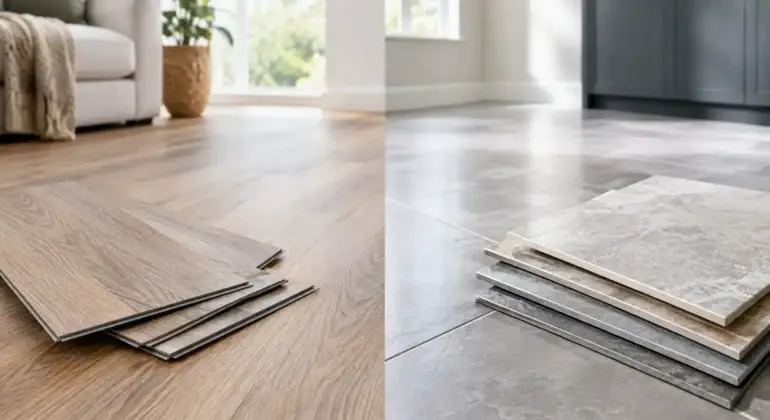
Vinyl flooring is a resilient surface available in sheet vinyl, luxury vinyl plank (LVP), and luxury vinyl tile (LVT). Modern commercial-grade vinyl can closely replicate wood, stone, and concrete while providing a warmer, quieter surface underfoot. It is often chosen when speed, budget control, and ease of replacement matter.
Tile includes ceramic, porcelain, and natural stone products. For most high-use commercial and residential applications, porcelain is the leading option because it is dense, durable, and highly resistant to water absorption. Tile provides a hard, permanent finish with a wide range of sizes, textures, and visual styles.
Neither is universally better. A well-run flooring project starts with the conditions of the room, not a preference formed from a sample board.
Where vinyl has a practical advantage
Vinyl is often the more forgiving choice for tenant improvements, occupied renovations, and spaces where limiting downtime is a priority. Floating LVP and LVT systems can be installed efficiently when the existing floor and subfloor meet the manufacturer’s requirements. In certain renovations, vinyl may also be installed over a suitable existing surface, reducing demolition and disposal work.
Comfort is one of vinyl’s clearest benefits. It has more give than tile, which can make a meaningful difference for employees standing at service counters, retail associates working long shifts, or homeowners spending hours in a kitchen. Vinyl also tends to reduce footfall noise, an advantage in offices, multi-family homes, and upper-floor suites.
Maintenance is straightforward. Regular sweeping and manufacturer-approved cleaning products are usually enough to maintain the surface. Because there are no grout joints, vinyl does not require grout sealing or periodic grout cleaning. Individual planks or tiles can often be replaced if damage is localized, provided matching material has been retained.
Water resistance varies by product and installation method. Many vinyl products are waterproof at the surface, making them suitable for kitchens, washrooms, entry areas, and basement renovations. That does not mean moisture beneath the floor can be ignored. Water can still reach seams, wall edges, adhesives, or the subfloor, particularly after a leak or flood. Proper moisture testing and preparation remain essential.
Vinyl also has limitations. Sharp objects, dragged equipment, heavy point loads, and certain rubber-backed mats can mark or stain some products. Direct sunlight may cause fading or expansion in rooms with significant glazing unless the selected product and installation method are designed for that exposure. In premium settings where an authentic natural-material finish is central to the design, some clients may also prefer the depth and permanence of tile.
Why tile remains a high-performance choice
Tile earns its reputation in areas that face frequent water, intensive cleaning, and heavy traffic. Properly installed porcelain tile is highly resistant to scratches, moisture, and wear. It is an excellent fit for commercial washrooms, building entrances, restaurant kitchens, laundry rooms, shower areas, and residential mudrooms.
The visual value of tile is equally important. Large-format porcelain can create a clean, refined appearance in lobbies, retail interiors, and contemporary homes. Textured finishes can improve traction in wet areas, while a carefully selected grout color can either blend into the design or define the layout. Tile also performs well with radiant floor heating, offering a comfortable solution in bathrooms and other areas where a warmer surface is desired.
Its greatest strengths are also tied to its installation demands. Tile is rigid, so the substrate must be flat, stable, and suitable for the tile size being installed. Movement in a wood subfloor, an uneven concrete slab, or an incorrectly built underlayment can lead to cracked grout or tile. A professional installation may require demolition, leveling, crack isolation, waterproofing, and curing time before the space can return to service.
Grout requires attention as well. While quality grout products and proper sealing can reduce staining, grout lines will generally need more cleaning than a vinyl surface. A narrow grout joint and appropriate grout selection can make maintenance easier, but this should be planned before installation rather than treated as an afterthought.
Tile is harder and cooler underfoot than vinyl. That can be ideal in warm, wet, or high-traffic zones, but it may not be as comfortable in a workplace where people stand for long periods. If a tile breaks, repairs are possible, though matching replacement tile may be difficult if the original product has been discontinued.
Cost is more than the material price
Comparing a box price of vinyl with a square-foot price of tile rarely tells the full story. Vinyl often has a lower installed cost because it generally requires less labor and can involve less floor build-up. It can be a smart choice when a project needs a clean, durable finish without extending the construction schedule.
Tile typically costs more to install because it is labor-intensive and demands careful substrate preparation. The finished product can deliver a long service life, but only if the assembly below it is correctly built. Skipping preparation to reduce the initial price is one of the most expensive mistakes a property owner can make.
For commercial work, factor in business interruption as well as installation cost. A floor that takes longer to install may affect opening dates, employee access, furniture moves, or coordination with other trades. A detailed estimate should identify demolition, floor leveling, moisture mitigation, transitions, baseboards, trim work, disposal, and any required waterproofing so there are fewer surprises once work begins.
Match the floor to the room
For offices, clinics, retail suites, and rental turnover projects, commercial-grade LVT or LVP is often a practical fit. It offers a polished appearance, manageable maintenance, and faster installation. It can also coordinate well with acoustic ceilings, painted finishes, millwork, and glass partitions in a complete interior build-out.
For washrooms, showers, commercial kitchens, vestibules, and other areas where standing water or aggressive cleaning is expected, porcelain tile is often the stronger long-term choice. The system should include the correct waterproofing, slope where needed, and slip-resistant tile selection. A beautiful tile is not a good finish if it creates a safety concern when wet.
In homes, the answer can vary room by room. Vinyl may suit a finished basement, bedroom, family room, or kitchen where warmth and comfort matter. Tile may be the better choice for a bathroom, entryway, fireplace surround, or mudroom. Combining materials thoughtfully can provide better performance than forcing one product throughout the entire property.
Installation quality determines the result
The visible surface is only one part of a durable floor. Before vinyl is installed, the subfloor must be clean, dry, flat, and free from movement. Before tile is installed, the substrate must be structurally sound and prepared to control cracking and moisture. These steps are not optional extras. They protect the investment in the finished space.
This is particularly relevant in Lower Mainland renovations, where concrete moisture, aging subfloors, and previous water damage can affect flooring performance. An experienced contractor should inspect the existing conditions, explain the preparation required, and coordinate flooring with doors, transitions, cabinetry, baseboards, and adjacent finishes.
Shivaji Construction approaches flooring as part of the complete interior system, not an isolated trade. Clear scope planning, clean worksites, quality materials, and accountable coordination help clients avoid the gaps that can occur when several contractors are working independently.
Make the decision with the next five years in mind
Choose vinyl when you need a comfortable, attractive, water-resistant floor that can be installed efficiently and maintained with minimal effort. Choose tile when the space faces heavy moisture, demanding traffic, or calls for a hard-wearing architectural finish that can last for decades.
Before selecting either material, bring samples into the actual space, review the lighting, ask how the floor will be cleaned, and confirm what preparation the existing substrate requires. The right floor is the one that continues to look professional and perform reliably long after the project is complete.